Many ââårock Puristsã¢ââ Viewed Art Rock in a Negative Light Which of These Reasons Is Most True

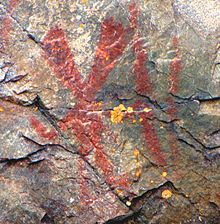
Petroglyph attributed to Classic Vernal Manner, Fremont archaeological culture, eastern Utah, United States

Reclining Buddha at Gal Vihara, Sri Lanka where the remains of the image house that originally enclosed is visible
In archaeology, stone fine art is human-made markings placed on natural surfaces, typically vertical stone surfaces. A loftier proportion of surviving celebrated and prehistoric rock fine art is found in caves or partly enclosed rock shelters; this type also may be called cave fine art or parietal art. A global phenomenon, rock fine art is found in many culturally diverse regions of the world. It has been produced in many contexts throughout human being history. In terms of technique, the master groups are: petroglyphs, which are carved or scratched into the rock surface, cave paintings, and sculpted stone reliefs. Another technique creates geoglyphs that are formed on the ground. The oldest known stone art dates from the Upper Palaeolithic period, having been institute in Europe, Australia, Asia, and Africa. Anthropologists studying these artworks believe that they likely had magico-religious significance.
The archaeological sub-discipline of rock fine art studies showtime developed in the belatedly-19th century among Francophone scholars studying the rock art of the Upper Palaeolithic found in the cave systems of parts of Western Europe. Rock art continues to be of importance to indigenous peoples in various parts of the world, who view them every bit both sacred items and pregnant components of their cultural heritage.[one] Such archaeological sites may become significant sources of cultural tourism and take been used in popular culture for their aesthetic qualities.[2]
Etymology [edit]
The term rock fine art appears in the published literature equally early on as the 1940s.[iii] [4] Information technology has also been described as "stone carvings",[5] "stone drawings",[vi] "rock engravings",[vii] "rock inscriptions",[8] "rock paintings",[9] "rock pictures",[10] "rock records",[xi] and "rock sculptures.[12] [xiii]
Background [edit]
Parietal fine art is a term for fine art in caves, the definition usually extended to art in rock shelters nether cliff overhangs. Popularly, information technology is called "cave fine art", and is a subset of the wider term, rock art. It is mostly on stone walls, but may be on ceilings and floors. A broad diversity of techniques have been used in its creation. The term unremarkably is practical only to prehistoric art, simply it may exist used for art of any engagement.[14] Sheltered parietal fine art has had a far better chance of surviving for very long periods, and what now survives may represent only a very small proportion of what was created.[15]
Both parietal and cavern art refer to cave paintings, drawings, etchings, carvings, and pecked artwork on the interior of caves and rock shelters. Generally, these either are engraved (essentially significant scratched) or painted, or, they are created using a combination of the two techniques.[16] Parietal art is institute very widely throughout the world, and in many places new examples are existence discovered.
The defining characteristic of rock art is that it is placed on natural rock surfaces; in this mode it is distinct from artworks placed on constructed walls or free-standing sculpture.[17] As such, rock art is a form of landscape fine art, and includes designs that have been placed on bedrock and cliff faces, cave walls, and ceilings, and on the ground surface.[17] Rock fine art is a global phenomenon, existence found in many different regions of the world.[1] There are various forms of rock art. Some archaeologists too consider pits and grooves in the stone known equally cupules, or cups or rings, as a course of rock art.[17]
Although at that place are exceptions, the majority of rock art whose creation was recorded by ethnographers had been produced during rituals.[17] Every bit such, the study of rock art is a component of the archaeology of organized religion.[18]
Rock fine art serves multiple purposes in the contemporary earth. In several regions, it remains spiritually important to indigenous peoples, who view information technology every bit a significant component of their cultural heritage.[1] It also serves as an important source of cultural tourism, and hence as economic revenue in sure parts of the globe. As such, images taken from cave art take appeared on memorabilia and other artefacts sold as a part of the tourist manufacture.[two]
Types [edit]

Paintings [edit]
In most climates, only paintings in sheltered site, in item caves, have survived for any length of time. Therefore, these are usually called "cavern paintings", although many do survive in "rock-shelters" or cliff-faces under an overhang. In prehistoric times these were often pop places for various human purposes, providing some shelter from the weather, as well as light. There may have been many more paintings in more than exposed sites, that are now lost. Pictographs are paintings or drawings that take been placed onto the rock face up. Such artworks accept typically been fabricated with mineral earths and other natural compounds found across much of the globe. The predominantly used colours are cerise, black and white. Red paint is usually attained through the use of ground ochre, while black paint is typically composed of charcoal, or sometimes from minerals such as manganese. White paint is usually created from natural chalk, kaolinite dirt or diatomaceous earth.[19] Once the pigments had been obtained, they would be basis and mixed with a liquid, such every bit water, blood, urine, or egg yolk, and then practical to the stone as paint using a castor, fingers, or a stamp. Alternately, the pigment could have been applied on dry, such as with a stick of charcoal.[20] In some societies, the paint itself has symbolic and religious meaning; for instance, among hunter-gatherer groups in California, paint was just allowed to exist traded past the group shamans, while in other parts of Northward America, the give-and-take for "paint" was the aforementioned equally the word for "supernatural spirit".[21]
One common form of pictograph, establish in many, although not all stone-fine art producing cultures, is the hand print. There are three forms of this; the kickoff involves covering the hand in wet paint and then applying it to the rock. The second involves a design being painted onto the hand, which is then in plow added to the surface. The 3rd involves the mitt first being placed confronting the panel, with dry paint then beingness blown onto it through a tube, in a procedure that is alike to air-brush or spray-painting. The resulting epitome is a negative print of the paw, and is sometimes described as a "stencil" in Australian archeology.[22] Miniature stencilled art has been constitute at two locations in Australia and i in Indonesia.
Petroglyphs [edit]

Bidzar Petroglyphs in Cameroon
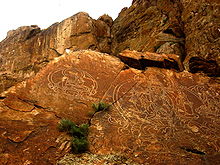
Petroglyphs are engravings or carvings into rock which is left in situ. They can be created with a range of scratching, engraving or carving techniques, often with the utilise of a hard hammerstone, which is battered against the stone surface. In certain societies, the choice of hammerstone itself has religious significance.[23] In other instances, the stone fine art is pecked out through indirect percussion, as a second rock is used like a chisel between the hammerstone and the panel.[23] A third, rarer form of engraving rock art was through incision, or scratching, into the surface of the rock with a lithic flake or metal bract. The motifs produced using this technique are fine-lined and often difficult to see.[24]
Rock reliefs [edit]
Normally plant in literate cultures, a rock relief or stone-cut relief is a relief sculpture carved on solid or "living rock" such as a cliff, rather than a detached slice of stone. They are a category of stone art, and sometimes institute in conjunction with rock-cut compages.[25] Notwithstanding, they tend to exist omitted in about works on stone art, which concentrate on engravings and paintings by prehistoric peoples. A few such works exploit the natural contours of the rock and utilise them to define an image, but they do not amount to human-made reliefs. Stone reliefs take been made in many cultures, and were peculiarly important in the fine art of the Ancient Virtually Eastward.[26] Rock reliefs are generally fairly large, every bit they need to be to make an bear upon in the open up air. Well-nigh have figures that are over life-size, and in many the figures are multiples of life-size.
Stylistically they ordinarily relate to other types of sculpture from the culture and period concerned, and except for Hittite and Persian examples they are generally discussed as part of that wider subject field.[27] The vertical relief is almost common, but reliefs on essentially horizontal surfaces are besides establish. The term typically excludes relief carvings inside caves, whether natural or themselves homo-made, which are especially plant in India. Natural rock formations made into statues or other sculpture in the round, most famously at the Great Sphinx of Giza, are also usually excluded. Reliefs on large boulders left in their natural location, like the Hittite İmamkullu relief, are likely to be included, just smaller boulders may be called stelae or carved orthostats.
Earth figures [edit]
Earth figures are large designs and motifs that are created on the rock footing surface. They can be classified through their method of manufacture.[28] Intaglios are created past scraping away the desert pavements (pebbles covering the ground) to reveal a negative epitome on the bedrock beneath. The best known example of such intaglio rock art is the Nazca Lines of Peru.[28] In contrast, geoglyphs are positive images, which are created by piling upwardly rocks on the ground surface to resulting in a visible motif or design.[28]
Motifs and panels [edit]
Traditionally, individual markings are called motifs and groups of motifs are known as panels. Sequences of panels are treated every bit archaeological sites. This method of classifying rock art even so has go less popular as the structure imposed is unlikely to accept had any relevance to the art'southward creators. Even the word 'art' carries with it many modern prejudices almost the purpose of the features.[ citation needed ]
Rock art can exist found across a wide geographical and temporal spread of cultures maybe to marker territory, to record historical events or stories or to assist enact rituals. Some art seems to describe real events whilst many other examples are apparently entirely abstract.[ citation needed ]
Prehistoric rock depictions were not purely descriptive. Each motif and design had a "deep significance" that is not always understandable to modern scholars.[29]
Interpretation and use [edit]
Religious interpretations [edit]
In many instances, the cosmos of stone art was itself a ritual deed.[24]
Regional variations [edit]
Europe [edit]
In the Upper Palaeolithic of Europe, rock art was produced inside cave systems by the hunter-gatherer peoples who inhabited the continent. The oldest known instance is the Chauvet Cave in France, although others have been located, including Lascaux in France, Alta Mira in Kingdom of spain and Creswell Crags in Britain and Grotta del Genovese in Sicily.
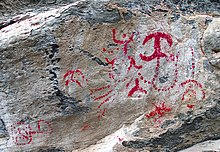
Balma dei Cervi post-palaeolithic rock paintings (Italian western Alps): antropomorphic figures and dottings (DStretch enhanced)
The late prehistoric rock art of Europe has been divided into three regions by archaeologists. In Atlantic Europe, the littoral seaboard on the west of the continent, which stretches from Iberia up through France and encompasses the British Isles, a variety of unlike rock arts were produced from the Neolithic through to the Belatedly Bronze Age. A second surface area of the continent to contain a meaning rock art tradition was that of Alpine Europe, with the majority of artworks being clustered in the southern slopes of the mountainous region, in what is now southward-eastern France and northern Italian republic.
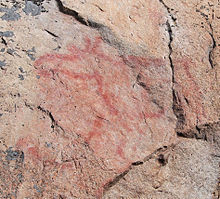
- Finnish Rock Fine art
- Knowth
- Loughcrew
- Newgrange
- Neolithic and Bronze Age stone art in the British Isles
- Rock Drawings in Valcamonica (World Heritage Site)
- Balma dei Cervi at Crodo (Piedmont - Italian Alps)
- Grotta dei Cervi at Porto Badisco (Apulia - Italy)
- Grotta del Genovese (Sicily)
- Listing of rock carvings in Norway
- Rock carvings at Alta (World Heritage Site)
- Madara Rider (Earth Heritage Site)
- Côa Valley Paleolithic Art (World Heritage Site)
- Cavern of Altamira and Paleolithic Cave Fine art of Northern Kingdom of spain (World Heritage Site)
- Stone art of the Iberian Mediterranean Basin (Earth Heritage Site)
- Tanum (World Heritage Site)
- Tanums hällristningsmuseum,[30] Rock Art Research Center and World Heritage Archive, situated in Tanum, Sweden.
Africa [edit]


Long-horned cattle and other rock art in the Laas Geel complex
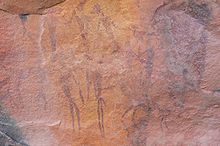

North Africa [edit]
- Southward Oran in Algeria.
- Saharan rock art
- Tadrart Acacus in Libya – World Heritage Site.
- Tassili north'Ajjer in Algeria – national park and World Heritage Site, known for its 10,000-year-old paintings.
- Cave of Swimmers is a cavern in southwest Egypt, near the border with Libya, along the western edge of the Gilf Kebir plateau in the cardinal Libyan Desert (Eastern Sahara). It was discovered in October 1933 by the Hungarian explorer László Almásy. The site contains rock paintings of human being figures who announced to be swimming, which accept been estimated to have been created at to the lowest degree half dozen,000 to 7000 years ago. The Cavern of Beasts 10 km westwards was discovered in 2002.
- Jebel Uweinat, a large granite and sandstone mountain, besides every bit the side by side smaller massifs of Jebel Arkenu and Jebel Kissu at the converging triple borders of Libya, Egypt and Sudan, harbors one of the richest concentrations of prehistoric rock art in the entire Sahara. The rock art here mainly consists of the Neolithic cattle pastoralist cultures, but also a number of older paintings from hunter-gatherer societies.
- Sabu-Jaddi rock art site in Northern Sudan.
- Due north Sİnai Archaeological Sites Zone − Globe Heritage Site.[31] Limestone cave decorated with scenes of animals such as donkeys, camels, deer, mule and mountain goats was uncovered in the site in 2020. Rock art cave is 15 meters deep and 20 meters high.[32]
- Wadi Abu Dom
Western Africa [edit]
- Boucle du Baoulé National Park
- Dabous Giraffes
East Africa [edit]
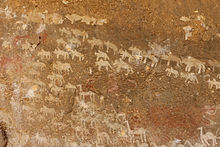
Rock art in the Adi Alauti cave, Eritrea
- Qohaito in Eritrea – 7,000 years old rock fine art near the aboriginal city Qohaito.
- Dorra and Balho in Republic of djibouti – Rock art sites with figures of what announced to be antelopes and a giraffe.
- Kundudo in Federal democratic republic of ethiopia – Flat pinnacle mountain circuitous with rock art in a cave.
- Laas Geel in Somalia – A number of cave paintings and petroglyphs can be found at various sites beyond the country. Among the nearly prominent examples of this is the rock art in Laas Geel, Dhambalin, Gaanlibah and Karinhegane.
- Nyero Rockpaintings, Uganda-World Heritage Site, pre-historic paintings was noticed earlier 1250 AD[33]
- Swaga Swaga Game Reserve in Tanzania – Archaeologists announced the discovery of ancient rock art with anthropomorphic figures in a good condition at the Amak'hee 4 rockshelter site. Paintings made with a ruby dye also contained buffalo heads, giraffe's head and cervix, domesticated cattle dated back to about several hundred years ago.[34] [35]
- Bahi stone paintings
- Chabbé
- Dhaymoole
- Handoga
- Kondoa Stone-Art Sites
- Mfangano Isle
- Rock fine art of Uganda
Southern Africa [edit]
Cave paintings are plant in most parts of Southern Africa that have rock overhangs with smooth surfaces. Among these sites are the cave sandstone of Natal, Orange Gratuitous State and Northward-Eastern Cape, the granite and Waterberg sandstone of the Northern Transvaal, and the Table Mount sandstone of the Southern and Western Cape.[36]
- UKhahlamba Drakensberg Park in South Africa – The site has paintings dated to around 3,000 years old and which are thought to have been fatigued by the San people and Khoisan people, who settled in the expanse some 8,000 years agone. The stone art depicts animals and humans and is thought to represent religious beliefs.
- Tsodilo Hills in Botswana – A Earth Heritage Site with rock art
- Brandberg Mountain (Daureb) in Namibia – It is one of the well-nigh important rock art localities on the African continent. Most visitors just see "The White Lady" shelter (which is neither white, nor a lady, the famous scene probably depicts a young boy in an initiation ceremony), however the upper reaches of the mountain is total of sites with prehistoric paintings, some of which rank among the finest creative achievements of prehistory.
- Bambata Cave, Zimbabwe- Animal paintings and human being drawings are supposed to be age from 2.000 to 20.000 years onetime[37] [38] [39]
- Mwela and Adjacent Areas Rock Fine art Site, Zambia
- Chongoni Rock Art Area
- Driekops Eiland
- Modderpoort Sacred Sites
- Nooitgedacht Glacial Pavements
- Nyambwezi Falls
- San rock art
- Twyfelfontein
- Wildebeest Kuil Rock Fine art Centre
The Americas [edit]

The oldest reliably dated rock fine art in the Americas is known as the "Horny Little Human." It is petroglyph depicting a stick effigy with an oversized phallus and carved in Lapa practise Santo, a cave in central-eastern Brazil.[40] The nearly important site is Serra da Capivara National Park at Piauí state. It is a UNESCO World Heritage Site with the largest drove in the American continent and 1 of the most studied.
A site including 8 miles of paintings or pictographs that is under report in Colombia, Due south America at Serranía de la Lindosa was revealed in November 2020.[41] Their age is suggested as existence 12,500 years former (c. 10,480 B.C.) by the anthropologists working on the site because of extinct fauna depicted.
Rock paintings or pictographs are located in many areas beyond Canada. In that location are over 400 sites attributed to the Ojibway from northern Saskatchewan to the Ottawa River.[42]
- Pomier Caves, Dominican Democracy
- Naj Tunich, Guatemala
- Rock Paintings of Sierra de San Francisco, Baja California, Mexico
- Sierra de Guadalupe cave paintings, Baja California, United mexican states
- Pictograph Cave Circuitous, Billings, Montana, United States
- Cañon Pintado, Colorado, The states
- Chaco Culture National Historical Park, New Mexico, The states
- Chumash rock art, California, U.s.
- Coso Rock Fine art Commune, California, United States
- Nine Mile Canyon, Utah, U.s.
- Quail rock art panel, Utah, United States
- Painted Rocks, Arizona, Usa
- Petroglyph National Monument, New Mexico, Us
- Serra da Capivara National Park, Piauí, Brazil
- Vale do Catimbau National Park, Pernambuco, Brazil.
- Localidad Rupestre de Chamangá, Uruguay
- Writing-on-Stone Provincial Park, Alberta, Canada
- Cueva de las Manos, Santa Cruz Province, Argentine republic
- Huerfano Butte, Arizona, United States
- Petroglyphs Provincial Park, Ontario, Canada
- Serranía La Lindosa, Guaviare Department, Colombia[43] [41]
Asia [edit]


Petroglyphs in Gobustan, Republic of azerbaijan, dating back to 10,000 BC.
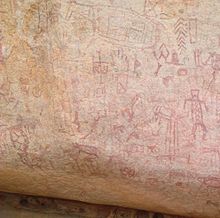
Rock art in Balichakra near Yadgir town in Karnataka, India
Central Asia [edit]
- Gobustan National Park in Azerbaijan
- Petroglyphs of Arpa-Uzen, Kazakhstan
- Siypantosh Rock Paintings in Uzbekistan
- Zarautsoy Rock Paintings in Uzbekistan
East asia [edit]
- Bangudae Petroglyphs, in Republic of korea
- Cheonjeon-ri in Republic of korea[44]
- Daegok-ri in South Korea[44]
- Fugoppe Cave petroglyphs on Hokkaido, Nippon[44]
- Helankou in Yinchuan, China[44]
- Kangjia shimenzi in Xinjiang, China[44]
- Oponoho (Wanshan) petroglpyhs in Taiwan[44]
- Temiya Cavern on Hokkaido, Japan[44]
- Yinshan petroglyphs in the Yin Mountains, People's republic of china
- Zuo River Huashan rock fine art in Guangxi, Red china[44]
- Higher up 4000 meters above sea level high Tibetan plateau: perchance the oldest stone art, likely dating back to ∼169–226,000 years ago, much older than what was previously idea to be the earliest known drawing, made ~73,000[45] years agone. According to the written report, children likely intentionally placed a series of hands and feet in mud. The findings could also be the primeval bear witness of Hominins on the loftier Tibetan plateau.[46] [47] [48]
Southeast Asia [edit]
- Angono Petroglyphs, the Philippines
- Bir Hima Rock Petroglyphs and Inscriptions
- Pettakere cavern, Due south Sulawesi, Indonesia – hand print paintings
- Pha Taem in Thailand
- Tambun rock fine art, Malaysia
Southward Asia [edit]
- Bhimbetka rock shelters (World Heritage Site), Madhya Pradesh, Bharat with rock art ranging from the Mesolithic (c.8,000 BC) to historical times[49] [50] [51] [52] [53] [54]
- Edakkal Caves, Kerala India
- Gavali, Udupi
- Hire Benakal, Karnataka
- Balichakra, Yadgir town in Karnataka, Bharat
- Rock paintings of Tamil Nadu, in India (several sites)[55]
- Kaimur district, Bihar, Republic of india (several sites)
- Stone paintings of Andhra Pradesh, in Republic of india (several sites)[55]
- Sonda, Karnataka
Western asia [edit]
- Stone Art in the Ha'il Region in Saudi Arabia
- Iranian stone fine art sites are mostly institute in the Zagros Mount range. But there are many other sites in Cardinal Iran, Sistan and Baluchistan, and Azarbaijan. Well-nigh of these rock arts date dorsum to the late prehistory and historic period. Amongst which the well-known sites of Houmian at Kuhdasht,[56] Khomein, and Teimareh[57] in Central Iran are outstanding.
- Large carvings of camels that were discovered in 2018 in Saudi arabia are estimated to be vii,000 to eight,000 years one-time.[58] This Neolithic dating would make the carvings significantly older than Stonehenge (v,000 years onetime) and the Egyptian pyramids at Giza (4,500 years old).
Australasia [edit]
Commonwealth of australia [edit]
Australian Ethnic art represents the oldest unbroken tradition of fine art in the world. There are more 100,000 recorded stone art sites in Australia.[59]
The oldest firmly dated rock-fine art painting in Australia is a charcoal drawing on a rock fragment found during the excavation of the Nawarla Gabarnmang rock shelter in south western Arnhem Land in the Northern Territory. Dated at 28,000 years, information technology is one of the oldest known pieces of rock art on Earth with a confirmed date. Nawarla Gabarnmang is considered[ by whom? ] to accept 1 of the well-nigh all-encompassing collections of rock art in the world and predates both Lascaux and Chauvet cave art - the earliest known fine art in Europe - by at least 10,000 years.[sixty] [61]
In 2008 rock art depicting what is thought to be a Thylacoleo was discovered[ by whom? ] on the northward-western coast of the Kimberley.[62] Equally the Thylacoleo is believed to accept become extinct 45000–46000 years ago (Roberts et al. 2001) (Gillespie 2004), this suggests a similar age for the associated Gwion Gwion rock paintings. Archeologist Kim Akerman withal believes that the megafauna may take persisted later in refugia (wetter areas of the continent) equally suggested by Wells (1985: 228) and has suggested a much younger historic period for the paintings.[62] Pigments from the Gwion Gwion of the Kimberley are and so old they have become part of the rock itself, making carbon dating impossible. Some experts suggest that these paintings are in the vicinity of 50,000 years one-time and may fifty-fifty pre-engagement Aboriginal settlement.[63] [64]
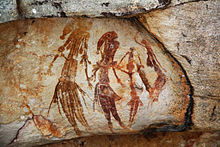
Miniature rock art of the stencilled variety at a rock shelter known as Yilbilinji, in the Limmen National Park in the Northern Territory, is one of just three known examples of such art. Usually stencilled art is life-size, using body parts as the stencil, but the 17 images of designs of homo figures, boomerangs, animals such every bit venereal and long-necked turtles, wavy lines and geometric shapes are very rare. Plant in 2017 by archaeologists, the only other recorded examples are at Nielson's Creek in New South Wales and at Kisar Island in Republic of indonesia. It is idea that the designs may have been created by stencils fashioned out of beeswax.[65] [66] [67]
- Kakadu National Park in the Northern Territory has a large drove of ochre paintings. Ochre is a not an organic fabric, so carbon dating of these pictures is impossible. Sometimes the approximate date, or at least an epoch, can exist guessed from the content.
- The Sydney region has of import stone engravings.
- Mountain Grenfell Historic Site near Cobar, western New Due south Wales has important ancient rock-drawings.
- The Murujuga (Burrup Peninsula) area of Western Australia about Karratha is estimated[ past whom? ] to be dwelling house to between 500,000 and 1 million individual engravings.
- Kimberley region of Western Australia. Amateur archaeologist Grahame Walsh, who researched Gwion Gwion rock paintings in the region from 1977 until his death in 2007, produced a photographic database of 1.5 million Gwion Gwion stone paintings.[68] Many of the Gwion rock paintings maintain vivid colours because they have been colonised by leaner and fungi, such as the black fungus, Chaetothyriales. The pigments originally applied may accept initiated an ongoing, symbiotic relationship between blackness fungi and ruddy bacteria.[69]
- The Grampians-Gariwerd region is Victoria is one of the richest Aboriginal stone art sites in south-eastern Commonwealth of australia.[70] Some of the more well-known and easily accessible sites are the Ngamadjidj Shelter (Cavern of Ghosts), Gulgurn Manja (Flat Rock), Billimina (Glenisla Shelter) and Manja (Cavern of Hands);[71] one of the nigh significant sites in south-eastern Australia is Bunjil's Shelter, nigh Stawell,[72] which is the only known stone art delineation of Bunjil, the creator-being in Ancient Australian mythology.[73]
- The Maliwawa Figures in Arnhem Land, a series of 571 paintings and a drawing, created between 6,000 and 9,400 years ago, show a style nor recognised by researchers in the field before new research was done in 2016–2018 and published in September 2020 by Paul Taçon and his team.[74] [75]
- The Turramurra site in western Queensland is opening in 2020. Cliffs on the property, for some time known as Grace Vale Station, are covered with ancient rock art, including paintings and etchings of megafauna, emu symbols and the traditional songline of the Seven Sisters. Planning for an educational centre created from local stone is under fashion.[76]
New Zealand [edit]
In New Zealand, North Otago and South Canterbury take a rich range of early on Māori rock art.[77]
- The Takiroa Rock Art Shelter near Duntroon contains Māori artwork made from ochre and charcoal.[78]
Studies [edit]
The archaeological sub-discipline devoted to the investigation of rock art is known as "stone art studies." Rock art specialist David Southward. Whitley noted that inquiry in this surface area required an "integrated effort" that brings together archaeological theory, method, fieldwork, analytical techniques and interpretation.[79]
History [edit]
Although French archaeologists had undertaken much research into rock art, Anglophone archeology had largely neglected the subject for decades.[eighty]
The field of study of rock art studies witnessed what Whitley chosen a "revolution" during the 1980s and 1990s, every bit increasing numbers of archaeologists in the Anglophone world and Latin America turned their attending to the subject.[81] In doing so, they recognised that rock art could be used to empathize symbolic and religious systems, gender relations, cultural boundaries, cultural change and the origins of art and conventionalities.[1] One of the most meaning figures in this motion was the South African archaeologist David Lewis-Williams, who published his studies of San rock art from southern Africa, in which he combined ethnographic information to reveal the original purpose of the artworks. Lewis-Williams would come up to be praised for elevating rock art studies to a "theoretically sophisticated research domain" by Whitley.[82] All the same, the study of rock art worldwide is marked past considerable differences of opinion with respect to the ceremoniousness of diverse methods and the most relevant and defensible theoretical framework.
International databases and archives [edit]
The UNESCO World Rock Art Archive Working Group met in 2011 to discuss the base of operations model for a World Rock Art Archive.[83] While no official output has been generated to date various projects around the world, such every bit for example The Global Rock Art Database,[84] [85] are looking at making stone fine art heritage information more accessible and more visible to assist with rock art awareness, conservation and preservation issues.
See also [edit]
- List of Rock Age art
- The Kindness Rock Project
Notes [edit]
- ^ a b c d Whitley 2005, p. 1.
- ^ a b Whitley 2005, pp. ane–two.
- ^ E. Goodall, Proceedings and Transactions of the Rhodesian Scientific Clan 41:57-62, 1946: "Domestic Animals in rock art"
- ^ Eastward. Goodall, Proceedings and Transactions of the Rhodesian Scientific Clan 42:69-74, 1949: "Notes on certain human representations in Rhodesian rock art"
- ^ H. M. Chadwick, Origin Eng. Nation xii. 306, 1907: "The stone-carvings at Tegneby"
- ^ H. A. Winkler, Rock-Drawings of Southern Upper Egypt I. 26, 1938: "The discovery of rock-drawings showing boats of a type strange to Egypt."
- ^ H. G. Wells, Outl. Hist. I. xvii. 126/1, 1920: From stone engravings nosotros may deduce the theory that the desert was crossed from oasis to oasis.
- ^ Deutsch, Rem. 177, 1874: "The long rock-inscription of Hamamât."
- ^ Encycl. Relig. & Ethics I. 822/ii, 1908: "The stone-paintings are either stenciled or painted in outline."
- ^ Human being No. 119. 178/2, 1939: "On one of the stalactite pillars was found a big round rock with traces of crimson paint on its surface, as used in the stone-pictures"
- ^ G. Moore, The Lost Tribes and the Saxons of the Eastward, 1861, Championship page: "with translations of Stone-Records in India."
- ^ Tylor, Early on Hist. Human. v. 88, 1865, "and bush fine art or bushmen art."
- ^ Trust For African Rock Art, East Africa, mutual terminology, "Rock-sculptures may oftentimes be symbolic purlieus marks."
- ^ Bahn, 99-101
- ^ Bahn, 101
- ^ Bahn, 101-105
- ^ a b c d Whitley 2005, p. three.
- ^ Whitley 2005. pp. 3–4.
- ^ Whitley 2005, p. 4.
- ^ Whitley 2005, pp. 4–5.
- ^ Whitley 2005, p. nine.
- ^ Whitley 2005, pp. vii–9.
- ^ a b Whitley 2005, p. 11.
- ^ a b Whitley 2005, p. 13.
- ^ Harmanşah (2014), 5–6
- ^ Harmanşah (2014), five–6; Canepa, 53
- ^ for example past Rawson and Sickman & Soper
- ^ a b c Whitley 2005, p. fourteen.
- ^ Arca 2004, p. 319.
- ^ "Scandinavian Society for Prehistoric Art". www.rockartscandinavia.se. Archived from the original on 2013-x-25. Retrieved 2022-03-01 .
- ^ Centre, UNESCO World Heritage. "North Sinai archaeological Sites Zone". UNESCO World Heritage Heart . Retrieved 2020-09-09 .
- ^ "Aboriginal cave with distinguished engravings depicting scenes of animals discovered in Sinai - Ancient Arab republic of egypt - Heritage". Ahram Online . Retrieved 2020-09-09 .
- ^ "NYERO & OTHER Stone ARTSITES IN EASTERN UGANDA" (PDF).
- ^ "Tanzanian Rock Fine art Depicts Trios of Bizarre Anthropomorphic Figures | Archeology | Sci-News.com". Breaking Science News | Sci-News.com . Retrieved 2021-02-sixteen .
- ^ "Mysterious and bizarre: scientists discovered ancient rock art that dates back to several hundred years ago". www.msn.com . Retrieved 2021-02-16 .
- ^ Standard Encyclopaedia of Southern Africa (1973)
- ^ "Stone Historic period - Africa". Encyclopedia Britannica . Retrieved 2018-ten-20 .
- ^ "Big Cave Camp | Famous Rock Art Galleries - visits to Nswatugi cave, Bambata, Silozwane cavern, Inanke cave and Maholoholo cave". Big Cavern . Retrieved 2018-10-twenty .
- ^ https://austria-forum.org/, Republic of austria-Forum |. "Rock Paintings Bambata Cave (one)". Global-Geography . Retrieved 2018-10-xx .
- ^ Choi, Charles. "Telephone call this ancient rock etching 'piddling horny human being'." Scientific discipline on NBC News. 22 Feb 2012. Retrieved ix Apr 2012.
- ^ a b Alberge, Dalya, 'Sistine Chapel of the ancients' rock art discovered in remote Amazon wood, The Guardian, Sunday, November 29, 2020
- ^ Grace Rajnovich. (1994) Reading rock art: interpreting the Indian rock paintings of the Canadian Shield. Toronto:Natural Heritage/Natural History Inc.
- ^ "Research news - Newly discovered Amazon rock art testify the rainforest's earliest inhabitants living with giant Ice Age animals - University of Exeter". 2020-12-01. Archived from the original on 2020-12-01. Retrieved 2020-12-01 .
- ^ a b c d e f k h O'Sullivan, Rebecca (2018). "East Asia: Rock Fine art". Encyclopedia of Global Archaeology (2 ed.). Springer. pp. ane–11. doi:10.1007/978-three-319-51726-1_3131-1. ISBN978-3-319-51726-i.
- ^ Henshilwood, Christopher Due south.; d'Errico, Francesco; van Niekerk, Karen L.; Dayet, Laure; Queffelec, Alain; Pollarolo, Luca (October 2018). "An abstruse drawing from the 73,000-twelvemonth-old levels at Blombos Cave, South Africa" (PDF). Nature. 562 (7725): 115–118. doi:x.1038/s41586-018-0514-3. ISSN 1476-4687. PMID 30209394. S2CID 52197496.
- ^ Lanese, Nicoletta. "Kids' Fossilized Handprints May Be Some of the Globe's Oldest Art". Scientific American . Retrieved 17 October 2021.
- ^ Davis-Marks, Isis; Davis-Marks, Isis. "These 200,000-Year-One-time Hand and Footprints Could Be the Globe's Earliest Cavern Art". Smithsonian Mag . Retrieved 17 October 2021.
- ^ Zhang, David D.; Bennett, Matthew R.; Cheng, Hai; Wang, Leibin; Zhang, Haiwei; Reynolds, Emerge C.; Zhang, Shengda; Wang, Xiaoqing; Li, Teng; Urban, Tommy; Pei, Qing; Wu, Zhifeng; Zhang, Pu; Liu, Chunru; Wang, Yafeng; Wang, Cong; Zhang, Dongju; Lawrence Edwards, R. (10 September 2021). "Earliest parietal art: Hominin manus and foot traces from the middle Pleistocene of Tibet". Science Message. doi:10.1016/j.scib.2021.09.001. ISSN 2095-9273. S2CID 239102132.
- ^ "Stone Shelters of Bhimbetka". Globe Heritage Site. Retrieved 2007-02-xv .
- ^ Mathpal, Yashodhar (1984). Prehistoric Painting Of Bhimbetka. Abhinav Publications. p. 220. ISBN9788170171935.
- ^ Tiwari, Shiv Kumar (2000). Riddles of Indian Rockshelter Paintings. Sarup & Sons. p. 189. ISBN9788176250863.
- ^ Rock Shelters of Bhimbetka (PDF). UNESCO. 2003. p. 16.
- ^ Mithen, Steven (2011). After the Ice: A Global Human History, twenty,000 - 5000 BC. Orion. p. 524. ISBN9781780222592.
- ^ Javid, Ali; Jāvīd, ʻAlī; Javeed, Tabassum (2008). World Heritage Monuments and Related Edifices in India. Algora Publishing. p. xix. ISBN9780875864846.
- ^ a b "Chapter -ane Introduction to Rock Art in India" (PDF). [ expressionless link ]
- ^ Bewley, R. H. (1984). "The Cambridge University Archaeological Trek To Islamic republic of iran 1969. Excavations in Zagros Mountains : Homian, Mir Malas, Barde Spid". Iran. 22: 1. doi:10.2307/4299734. JSTOR 4299734.
- ^ Farhadi, M (1999). Museums in air current. Tehran: Allameh Tabataba'i University Printing.
- ^ Saudi arabia camel carvings dated to prehistoric era, BBC, September 15, 2021
- ^ Griffiths, Billy (2018). Deep Time Dreaming: Uncovering Ancient Commonwealth of australia. Blackness Inc. p. 176.
- ^ Barker, Bryce (18 June 2012). "Commonwealth of australia's oldest stone art discovered by USQ researcher". University of Southern Queensland. Archived from the original on 1 Feb 2014. Retrieved 20 January 2014.
- ^ Collis, Clarisa (June 2012). "Ancient artists of stone and soul". Monash University . Retrieved 20 January 2014.
- ^ a b Akerman, Kim; Willing, Tim (March 2009). "An ancient rock painting of a marsupial king of beasts, Thylacoleo carnifex, from the Kimberley, Western Australia". Antiquity . Retrieved 11 December 2012.
- ^ "The Times Literary Supplement – TLS". timesonline.co.u.k..
- ^ Bradshaw Foundation. "The Bradshaw Paintings – Australian Rock Fine art Archive". Bradshaw Foundation.
- ^ Zwartz, Henry (27 May 2020). "Indigenous rock art institute in the NT 1 of merely three such examples worldwide". ABC News (Australian Broadcasting Corporation) . Retrieved 28 May 2020.
- ^ Flinders University (26 May 2020). "Miniature rock art expands horizons". Phys.org . Retrieved 28 May 2020.
- ^ "Archaeologists reveal rock fine art's big little secret". Flinders Academy (News). 27 May 2020. Retrieved 28 May 2020.
- ^ "Rock Centre – Australian Story". abc.net.au. 15 Oct 2002.
- ^ "Aboriginal rock fine art'southward colours come from microbes". BBC News. 27 December 2010.
- ^ "National Heritage Places - Grampians National Park (Gariwerd)". Department of Agriculture, Water and the Surround. Australian Regime. Retrieved viii July 2020.
- ^ "Ancient Rock Art Sites" (PDF). Brambuk . Retrieved viii July 2020.
- ^ "Ancient Victoria, Grampians, Victoria, Australia". Visit Victoria. 5 Oct 2016. Retrieved 8 July 2020.
- ^ "Bunjil Shelter - Stawell, Attraction, Grampians, Victoria, Australia". Visit Victoria. 30 March 2020. Retrieved viii July 2020.
- ^ Taçon, Paul Southward. C.; May, Emerge K.; et al. (30 September 2020). "Maliwawa figures—a previously undescribed Arnhem Fifty and stone fine art manner". Australian Archæology. Informa United kingdom Limited. 86 (3): 208–225. doi:10.1080/03122417.2020.1818361. ISSN 0312-2417. S2CID 224849841 – via Taylor & Francis Online.
- ^ Weule, Genelle (1 Oct 2020). "'Bilbies', thylacines and dugongs among stunning Maliwawa rock art documented in Arnhem State". ABC News. ABC Science. Australian Broadcasting Corporation. Retrieved three October 2020.
- ^ Larkins, Damien (17 October 2020). "Indigenous story wall restored, open to visitors in outback Queensland". ABC News. Australian Broadcasting Corporation. Retrieved 21 October 2020.
- ^ Barrow, Terence (1978). Maori art of New Zealand (reprint ed.). Unesco Printing. p. seventy. ISBN9789231013195 . Retrieved 2018-03-06 .
The N Otago and Due south Canterbury districts of the Southward Island present a rich range of stone fine art in red and black pigments. The motifs used are mainly humans, monsters, birds, and fish, and are styles which pre-date Classic Maori traditional art.
- ^ McKinnon, Malcolm (29 July 2015). "Otago places - N Otago". Te Ara - the Encyclopedia of New Zealand . Retrieved 30 May 2019.
- ^ Whitley 2005, p. xi.
- ^ Whitley 2005. pp. viii, 1.
- ^ Whitley 2005, p. 10.
- ^ Whitley 2005, p. eight.
- ^ *UNESCO World Heritage Centre (2011). "Globe Stone Art Athenaeum to meet in Tanum". Retrieved May i, 2011.
- ^ R., Haubt. "Stone-Art Database". www.rockartdatabase.com.
- ^ Haubt, R.A.; Tacon, P.S.C. (Oct 22, 2016). "A collaborative, ontological and data visualization model approach in a centralized rock art heritage platform". Journal of Archaeological Science: Reports. 10: 837–846. doi:10.1016/j.jasrep.2016.10.013.
References [edit]
- Arca, Andrea (2004). "The topographical engravings of Alpine rock-art: fields, settlements and agricultural landscapes". The Figured Landscapes of Rock-Art. Cambridge University Press. pp. 318–349.
- Bahn, Paul (ed), The Cambridge Illustrated History of Prehistoric Art, 1998, Cambridge University Press, ISBN 0521454735, 9780521454735, google books
- Devlet, Ekaterina (2001). "Rock Fine art and the Cloth Culture of Siberian and Cardinal Asian Shamanism" (PDF). The Archaeology of Shamanism. pp. 43–54. Retrieved April 1, 2007.
- Harmanşah, Ömür (ed) (2014), Of Rocks and Water: An Archaeology of Place, 2014, Oxbow Books, ISBN 1782976744, 9781782976745
- Haubt, R.A.; Tacon, P.S.C. (October 22, 2016). "A collaborative, ontological and information visualization model approach in a centralized rock art heritage platform". Journal of Archaeological Science: Reports. ten: 837–846. doi:10.1016/j.jasrep.2016.10.013.
- Rawson, Jessica (ed). The British Museum Book of Chinese Fine art, 2007 (2d edn), British Museum Press, ISBN 9780714124469
- Schaafsma, Polly, 1980, Indian Rock Fine art of the Southwest, Schoolhouse of American Enquiry, Santa Fe, University of New United mexican states Press, Albuquerque NM, ISBN 0-8263-0913-five. Scholarly text with 349 references, 32 color plates, 283 blackness and white "figures", 11 maps, and two tables.
- Sickman, Laurence, in: Sickman L., & Soper A., The Art and Architecture of China, Pelican History of Art, 3rd ed 1971, Penguin (now Yale History of Fine art), LOC 70-125675
- UNESCO Earth Heritage Center (2011). "Globe Rock Art Archives to meet in Tanum". Retrieved May ane, 2011.
- Whitley, David S. (2005). Introduction to Rock Art Research. Walnut Creek, California: Left Declension Press. ISBN978-1598740004.
Further reading [edit]
- David, Bruno, Cavern Art, 2017, Thames and Hudson, ISBN 9780500204351
- Malotki, Ekkehart and Weaver, Donald Eastward. Jr., 2002, Stone Chisel and Yucca Castor: Colorado Plateau Rock Art, Kiva Publishing Inc., Walnut, California, ISBN 1-885772-27-0 (cloth). For the "general public"; this book has well over 200 color prints with commentary on each site where the photos were taken; the organisation begins with the primeval fine art and goes to modern times.
- B. B. Lal (1968). Indian Rock Paintings: Their Chronology, Technique and Preservation.
- Rohn, Arthur H. and Ferguson, William M, 2006, Puebloan Ruins of the Southwest, University of New Mexico Press, Albuquerque NM, ISBN 0-8263-3970-0 (pbk, : alk. paper). Adjunct to the master discussion of the ruins, contains color prints of rock art at the sites, plus interpretations.
- Zboray, András, 2005, Rock Fine art of the Libyan Desert, Fliegel Jezerniczky, Newbury, United Kingdom (1st Edition 2005, 2nd expanded edition 2009). An illustrated catalogue and bibliography of all known prehistoric rock art sites in the central Libyan Desert (Arkenu, Uweinat and the Gilf Kebir plateau). The second edition contains more that 20000 photographs documenting the sites. Published on DVD-ROM.
External links [edit]
- IFRAO International Federation of Rock Art Organizations, comprising lx academic rock art organizations of the earth. Some of these are:
- ARARA American Stone Art Research Association.
- ANISA Anisa, Verein für Tall Forschung.
- AURA Australian Rock Art Inquiry Association, Inc.
- CARA Cave Art Enquiry Association.
- IC Institutum Canarium.
- CeSMAP Centro Studi east Museo d'Arte Preistorica.
- CCSP Centro Camuno do Studi Preistorici.
- SCAO Società Cooperativa Archeologica Le Orme dell'Uomo.
- AARS Clan des Amis de l'art Rupestre Saharien.
- SIARB Bolivian Rock Art Enquiry Society.
- ANAR Archivo Nacional de Arte Rupestre (Venezuela).
- APAR Asociación Peruana de Arte Rupestre.
- AAV Asociación Arqueológica Viguesa.
- AEARC Asociación de Estudios del Arte Rupestre de Cochabamba.
- ABAR Associação Brasileira de Arte Rupestre.
- ASER Association de Sauvegarde, d'Etude et de Recherche pour le patrimoine naturel et culturel du Centre-Var.
- ESRARA Eastern States Stone Art Inquiry Association.
- GERSAR Groupe d'Études, de Recherches et de Sauvegarde de fifty'Art Rupestre.
- GCIAR Grupo Cubano de Investigaciones de Arte Rupestre.
- INAAK Instituto de Investigación de Arqueología y Antropología 'Kuelap'.
- NMMZ National Museums and Monuments of Zimbabwe.
- NRAF Nevada Rock Art Foundation.
- NCRAT Northern Greatcoat Rock Fine art Trust.
- SDRAA San Diego Rock Fine art Association.
- TARA The Trust for African Rock Fine art.
- Bradshaw Foundation Extensive archive on stone art from all around the globe.
- Altarockart.no A digital annal of the Rock Art of Alta, Norway
- Global Stone Fine art Database (RADB) rockartdatabase, Global Rock Art Database (RADB) search tool for international stone art athenaeum
- Maira Valley, Piedmont, Italy Rock Art in Maira Valley, Piedmont, Italy
- Chauvet Cavern Database of European Prehistoric Art
- England's Rock Fine art on the Web Access to the ERA database containing over 1500 records of stone art panels with images and 3D models.
- Tassili North'Ajjer, Rock Art of the central Tassili N'Ajjer (Tamrit, Sefar, Tin Tazarift, Jabbaren)
- Uweinat and the Gilf Kebir, Rock Fine art of Jebel Uweinat and the Gilf Kebir plateau ("Cavern of Swimmers")
- Upper Brandberg, The rock paintings of the Upper Brandberg, Namibia
- Libyan Desert, Rock Art of the Libyan Desert, and illustrated catalogue and bibliography of the prehistoric stone fine art of the central Libyan Desert
- Rupestreweb.info, Latin American rock fine art. Manufactures, Zones, News, Rock art researchers directory
- Tanums Hällristningsmuseum Archived 2013-10-25 at the Wayback Machine Rock Art Inquiry Centre and World Heritage Archive, situated in Tanum, Sweden.
- Rock Art Studies (RAS) – A Bibliographic database at the Bancroft Library containing over 18,000 citations to the globe's stone fine art literature.
- Rock Fine art Examples and Image Capture – Examples from the Côa Valley in Portugal and Magdalenian Rock Art.
- The Rock Fine art Foundation – Native American Rock Art in the Lower Pecos region of Southwest Texas
- Beckensall Archive Rock carvings made by Neolithic and Early Statuary Age people in Northumberland in the north east of England, between 6000 and 3500 years agone.
- British Rock Art Collection Over xvi.000 photos of more 1200 rock fine art sites in the UK with relevant information and links.
- Broken Stone Gallery and Petroglyph Designs.
- Rupestre.net A rock art site, mainly devoted to Valcamonica and Alpine Rock Fine art.
- EuroPreArt The database of European Prehistoric Art.
- Rock Art of the Murujuga (Burrup Peninsula) Western Australia
- Rock Art in S Africa
- UNESCO World Heritage: Rock Shelters of Bhimbetka
- Bundelkhand Rock Paintings, India
- SpiralZoom.com, an educational website most the scientific discipline of pattern germination, spirals in nature, spirals in the mythic imagination & spiral rock art
- Worldwide Stone Art Selection
- Prehistoric Stone Art in Iran
- Petroglyphs in Iran (In Western farsi)
- Sydney Rock Fine art
- Stone Art in Oregon
- Stone Fine art Enquiry Institute, University of Witwatersrand, Johannesburg, Southward Africa.
- Rock Fine art of the Lower Pecos, Texas Archive of the Moving Image
Source: https://en.wikipedia.org/wiki/Rock_art
0 Response to "Many ââårock Puristsã¢ââ Viewed Art Rock in a Negative Light Which of These Reasons Is Most True"
Post a Comment